

In 2026, the fear that AI will replace data analysts is finally being proven wrong. Instead, it's creating a new breed of high-earning "Decision Architects" who bridge the gap between raw numbers and strategic growth. You've likely felt overwhelmed by the explosion of new tools or worried that a simple spreadsheet skill set isn't enough to secure your future in India's competitive tech market. This data analytics career path guide is designed to eliminate that uncertainty. It shows you exactly how to transition into a role where you aren't just processing data; you're directing business outcomes.
We understand that a lack of structure is the biggest barrier to your success. You need a plan that moves beyond theory and into practical application. This guide provides a clear 12-month roadmap to mastery, covering everything from SQL and Python to AI-driven visualization. We'll validate the significant salary potential in the current market, where the global median for data professionals has climbed toward ₹70,00,000, and equip you with the confidence to apply for junior roles. By the end of this article, you'll have the blueprint to transform from a beginner into a sought-after professional in an industry projected to grow by 34% through 2034.
Key Takeaways
- Identify the specific milestones required to transition from a beginner to a high-earning "Decision Architect" in the 2026 Indian job market.
- Utilize this data analytics career path guide to navigate the shift from manual reporting to AI-augmented strategic analysis.
- Leverage your existing domain expertise in sectors like Finance or HR to stand out as a specialist rather than a generalist.
- Execute a structured two-phase roadmap designed to build both technical mastery in SQL and Python and a portfolio of real-world projects.
- Determine why industry-led mentorship and practical application are essential for closing the gap between certification and professional readiness.
Navigating the Data Analytics Landscape in 2026
The year 2026 marks the definitive arrival of the "Golden Age" for data professionals. While skeptics once predicted that generative AI would replace the need for human analysts, the reality is the opposite. AI has successfully automated the repetitive, low-value tasks of data cleaning and basic sorting. This shift has liberated you to become a "Strategic Decision Architect." In this data analytics career path guide, we explore how your value now lies in your ability to ask the right questions rather than just performing the calculations. You aren't just a cog in the machine; you're the one directing where the machine goes.
The demand across the country is staggering. From retail giants optimizing their supply chains to fintech startups predicting customer churn, data literacy is the new universal language of business. Firms are no longer looking for simple spreadsheet operators. They're hunting for professionals who can turn raw noise into strategic signals that impact the bottom line. With the global data analytics market projected to reach $104.39 billion by the end of 2026, the opportunities for those who can bridge the gap between data and strategy have never been greater.
The Core Purpose of Modern Data Analytics
Data analysis serves as the essential bridge between raw, chaotic information and profitable, evidence-based action. It's a continuous "Insight-to-Impact" loop where you don't just present numbers; you drive change. In 2026, the industry has moved beyond simple reporting. You'll master descriptive analytics to understand history, predictive analytics to anticipate trends, and prescriptive analytics to recommend the exact path forward. This progression ensures your work directly correlates with business growth and keeps you indispensable to your organization.
Data Analytics vs. Data Science: Choosing Your Path
Understanding the distinction between these two fields is vital for your journey. Think of Data Science as the "How," focusing on building the underlying models and algorithms. Analytics is the "What," centered on interpreting those results to solve specific business challenges. If you love deep coding and building complex systems from scratch, you might be a builder. However, if you enjoy finding the narrative within the numbers and influencing leadership through storytelling, you're a natural analyst. Starting in analytics is often the fastest, most effective route for career changers because it prioritizes business logic over high-level engineering. It's the most efficient way to secure your place in this high-growth sector.
The Data Analytics Career Ladder: From Entry-Level to Leadership
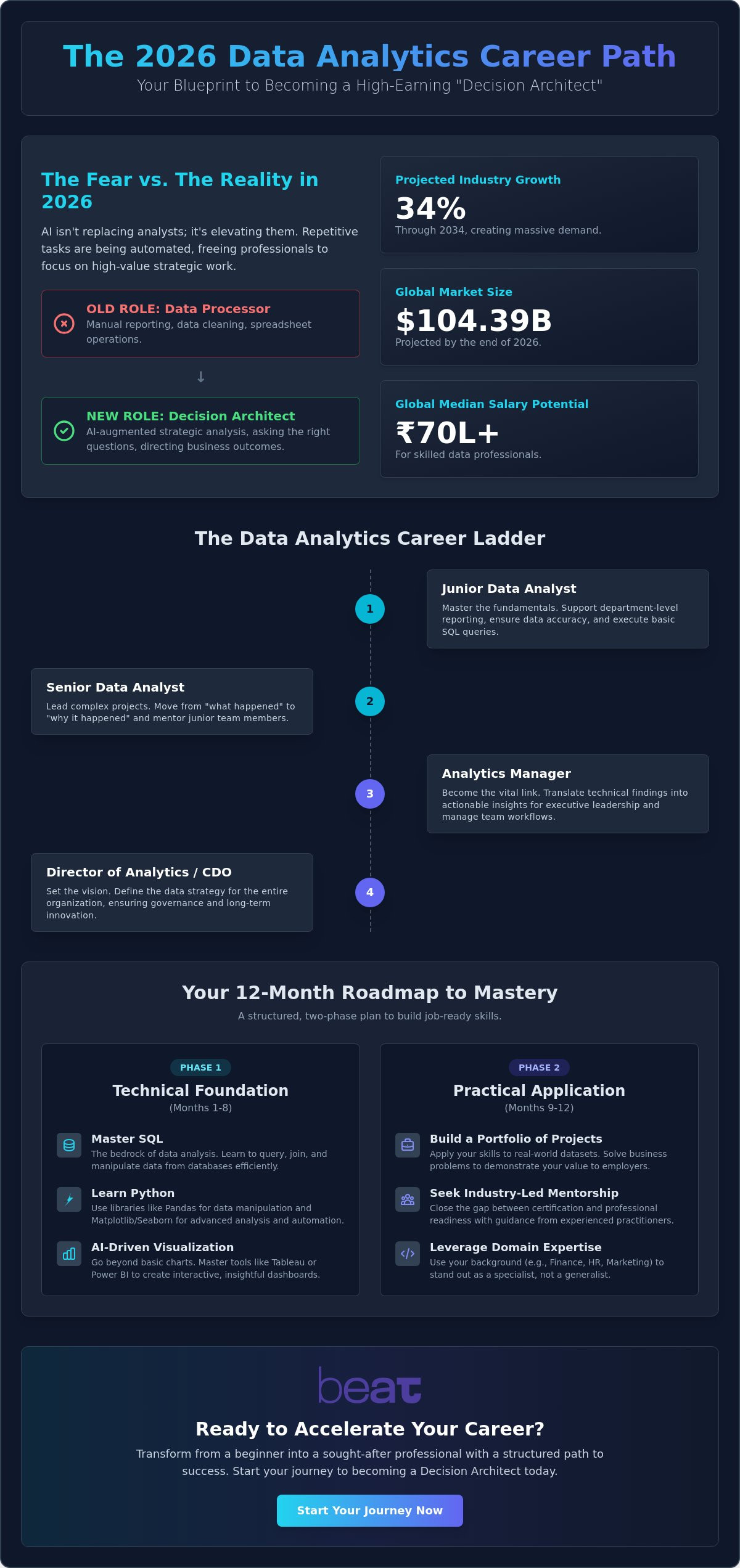
Scaling the professional heights of the data world requires more than just technical proficiency; it demands a strategic evolution of your mindset. This data analytics career path guide outlines the natural progression from executing tasks to architecting organizational success. In the Indian market, where tech hubs like Bengaluru, Hyderabad, and Pune are booming, understanding these milestones is essential for negotiating your worth and choosing the right specialization. You aren't just moving up a ladder. You're expanding your sphere of influence and increasing your value to the global economy.
- Junior Data Analyst: You start by mastering the fundamentals. Your day involves supporting department-level reporting and ensuring data accuracy for specific teams.
- Senior Data Analyst: At this stage, you lead complex projects. You move beyond answering "what happened" to explaining "why it happened" while mentoring junior team members.
- Analytics Manager: You become the vital link. Your role is to translate technical findings into actionable insights for executive leadership and manage team workflows.
- Director of Analytics / CDO: As a visionary leader, you set the data strategy for the entire organization, ensuring data governance and long-term innovation across all business units.
Entry-Level Roles: Your Foot in the Door
Securing your first role often involves titles like Junior Analyst, Business Intelligence Associate, or Marketing Analyst. Your primary responsibilities will include data hygiene, dashboard maintenance, and executing basic SQL queries to support senior staff. Many beginners struggle with the "experience gap" where entry-level jobs seem to require years of prior work. To bypass this barrier, participating in a structured Internship Training Program provides the real-world exposure needed to prove your readiness to recruiters immediately. It's about showing you can handle live data, not just classroom exercises.
Mid-Senior Transitions: Scaling Your Impact
The transition to senior levels is marked by a shift from "taking requests" to "proposing solutions." You'll find yourself identifying business problems before leadership even notices them. This is often when professionals specialize into roles like Analytics Engineer or Product Analyst. Mastering Advanced Excel and predictive modeling is frequently the catalyst for a significant salary jump. In 2026, the ability to build and maintain data pipelines using Python and SQL is what separates high earners from the rest of the pack. It's about becoming a proactive partner in the company's growth rather than a reactive reporter. By proposing data-driven strategies, you validate your position as a future leader.
Essential Skills for 2026: Bridging the Gap for Non-Tech Professionals
Your background in HR, finance, or marketing isn't a hurdle; it's your greatest competitive edge in the current market. In 2026, companies in India are moving away from hiring "pure" technologists who lack business context. They want professionals who understand why a 5% dip in customer retention matters for the quarterly bottom line in Mumbai's retail sector or how talent churn impacts a tech firm in Hyderabad. This data analytics career path guide emphasizes that domain expertise is your secret weapon. When you combine your existing industry knowledge with a targeted technical stack, you become a "Decision Architect" who can speak both the language of data and the language of the boardroom.
The modern analyst doesn't work in isolation. You'll use AI as a high-powered co-pilot to accelerate your workflow. Instead of spending hours debugging a Python script, you'll use Large Language Models (LLMs) to generate boilerplate code and perform initial data cleaning. This shift allows you to focus on high-level strategy and complex problem-solving. By embracing AI literacy, you bypass the technical intimidation that used to stop non-tech professionals from entering the field. You're no longer limited by your ability to memorize syntax; you're empowered by your ability to direct the tools.
The 2026 Technical Toolkit
Success starts with a lean, high-impact stack designed for immediate workplace readiness:
- Mastering SQL: This remains the evergreen language of data retrieval. It's the first skill you should acquire to interact with any modern database.
- Python for Data Visualization: Move beyond basic charts. Python libraries like Pandas and NumPy allow you to create sophisticated, interactive visuals that tell a deeper story than a standard spreadsheet ever could.
- Advanced Excel: Don't skip the basics. Excel is still the backbone of Indian business operations, and mastering pivot tables and complex lookups is essential for daily agility.
Data Storytelling: The Skill That Gets You Promoted
Data is a dormant asset until you transform it into a narrative. Leadership doesn't just want to see a dashboard; they want to understand the "Why" behind the trends. To build a compelling narrative, you must master the art of data storytelling. This involves identifying the central business conflict, presenting the evidence through clean and intuitive dashboard design, and concluding with a clear, profitable recommendation. Professionals who can translate rows of numbers into a three-minute executive summary are the ones who climb the career ladder fastest. It's about making the complex feel simple and the uncertain feel actionable.
Step-by-Step Roadmap to Your First Data Analytics Role
Transitioning into a new field feels daunting without a structured plan. This data analytics career path guide breaks your journey into four distinct, manageable phases designed to move you from a curious beginner to a job-ready professional in 12 months. Success in India's fast-paced tech hubs requires sequential mastery rather than trying to learn every tool simultaneously. By following this methodical approach, you build a foundation of informed confidence that recruiters notice immediately.
- Phase 1: Foundation Building (0-3 months): Focus on data logic and core tools. Master SQL for database retrieval and Advanced Excel for quick business calculations.
- Phase 2: Practical Application (4-6 months): Shift your focus to Python and data visualization. Learn to use Power BI or Tableau to turn complex datasets into clear, actionable dashboards.
- Phase 3: Portfolio and Branding (7-8 months): Document your journey. Showcase your best work on GitHub and optimize your LinkedIn profile to attract talent acquisition teams in cities like Bengaluru and Hyderabad.
- Phase 4: Targeted Networking and Interview Prep (9-12 months): Begin reaching out to industry peers. Practice live coding challenges and refine your ability to explain technical concepts to non-tech stakeholders.
Building a Portfolio That Recruits You
Recruiters in 2026 are tired of seeing the same generic Kaggle datasets on every resume. To capture their attention, you must solve real-world business problems that mirror the challenges they face daily. A portfolio is a proof of work, not just a list of files. Instead of just showing code, include a "Business Impact" section for every project. Explain how your analysis could potentially save a company ₹5,00,000 in operational costs or increase customer retention by 10%. This results-driven approach proves you understand the bottom line.
Mastering the Data Analytics Interview
The interview process is your stage to prove you're a strategic partner, not just a technician. You'll face technical tests involving live SQL queries and logic challenges designed to see how you think under pressure. Beyond the code, the behavioral round is where you demonstrate your ability to collaborate with cross-functional teams. Using a recognized Data Analytics certification helps validate your expertise and provides the institutional reliability that Indian employers value. It acts as a bridge between your theoretical knowledge and professional employment. To accelerate your progress and gain the mentorship needed to ace these rounds, enroll in a specialized Data Analytics program today and secure your future as a high-earning professional.
Accelerating Your Career with Professional Certification and Placement
Acquiring the right skills is only half the battle. Many aspiring professionals finish online courses only to find themselves stuck at the application stage, unable to secure an interview. This is the "Placement Gap," and it's the primary reason why self-paced video tutorials often fail to deliver real-world results. In 2026, the most effective data analytics career path guide emphasizes the shift toward instructor-led training. Live interaction provides the accountability and real-time feedback that pre-recorded content lacks. You need a mentor who can correct your logic in the moment, not a video you can pause and forget.
The value of mentorship cannot be overstated. Learning from industry veterans with 15 or more years of experience gives you access to "tribal knowledge" that isn't found in textbooks. These experts teach you how to handle messy, real-world data and how to navigate the specific corporate cultures of India's leading tech firms. BEAT Education acts as a dedicated partner in this journey. We focus on transforming beginners into workplace-ready professionals by bridging the link between theoretical mastery and professional employment. Our placement assistance ensures your resume doesn't just sit in a database but reaches the hands of hiring managers who value your practical expertise.
Choosing the Right Training Partner
Success depends on selecting a program that prioritizes your future employability. When evaluating options, look for these critical features:
- Practical Project Focus: Choose curricula that emphasize building a portfolio over passing multiple-choice theoretical exams.
- Dedicated Placement Cell: Ensure the provider offers active assistance, including resume building workshops and mock interview sessions tailored to the Indian market.
- Global Recognition: Your certification should carry weight not just locally, but with international firms operating in hubs like Bengaluru and Delhi.
Final Call to Action: Your Career Transformation Starts Today
The window of opportunity in the data sector is wide, but it rewards those who move with purpose. You've spent enough time researching and planning. Now is the moment to start doing. The risk of professional stagnation is far greater than the challenge of learning a new skill. By choosing a structured path, you protect your career against future volatility and position yourself for the high-earning roles of tomorrow. Explore the Data Analytics course with placement at BEAT Education and take the first definitive step toward becoming a Decision Architect. Your roadmap is clear. Your future is waiting. Don't let another year pass in a role that doesn't challenge your potential.
Claim Your Place in the Data Revolution
You've explored the evolution of the analyst into a "Decision Architect" and learned how domain expertise in India's key sectors can accelerate your growth. This data analytics career path guide has provided the technical roadmap and strategic mindset needed to navigate the 2026 landscape. Success now depends on your willingness to bridge the gap between theory and real-world impact. It's time to stop observing the data revolution and start leading it.
Don't let the complexity of the field hold you back from achieving your professional goals. With over 15 years of industry experience and a legacy of training 100,000+ students globally, BEAT Education is your dedicated partner in this transition. You can launch your career with our Data Analytics course with placement assistance and gain the confidence that comes from expert mentorship. Our dedicated placement assistance program is designed to ensure you don't just learn; you get hired.
The demand for data-literate leaders is surging across India's tech hubs. Your journey from a beginner to a high-earning professional starts with a single, decisive action. Take that step today and build a career that's both future-proof and personally rewarding. Your transformation is within reach.
Frequently Asked Questions
Can I start a data analytics career without a degree in computer science?
Yes, you can absolutely enter the field without a computer science degree. Many successful professionals transition from backgrounds like finance, HR, or marketing. Your domain expertise is a significant advantage because it allows you to interpret data within a specific business context. By following a structured data analytics career path guide and mastering technical tools like SQL and Python, you demonstrate workplace readiness that often outweighs a traditional degree.
What is the average salary for an entry-level data analyst in 2026?
In 2026, entry-level salaries in India vary based on location and skill set, but the global median for data professionals continues to climb. While the US median wage for data scientists reached $112,590 in 2024, the Indian market offers highly competitive packages in tech hubs like Bengaluru and Hyderabad. You'll find that specialized skills in AI-driven analysis often lead to even higher starting offers. It's about the value you bring to the decision-making process.
How long does it take to learn data analytics from scratch?
It typically takes between six to twelve months to become job-ready if you follow a structured learning path. The first three months focus on foundational logic and tools like SQL. The subsequent months involve practical application through real-world projects and portfolio building. This data analytics career path guide suggests a 12-month roadmap to ensure you develop deep expertise rather than surface-level knowledge. Consistency and hands-on practice are the keys to accelerating this timeline.
Is Python or SQL more important for a beginner in data analytics?
SQL is the most critical starting point for any beginner. It's the universal language used to communicate with databases and retrieve raw information. Once you've mastered data retrieval, Python becomes essential for advanced visualization and automation. Think of SQL as your foundation and Python as your toolkit for scaling your impact. Both are vital, but starting with SQL allows you to contribute to business reporting almost immediately.
Will AI replace data analysts in the next 5 years?
AI won't replace analysts; instead, it will automate the routine tasks like data cleaning and basic sorting. This shift elevates your role to a "Decision Architect" where your human intuition and strategic thinking are more valuable than ever. The demand for data scientists is projected to grow 34% from 2024 to 2034. Organizations need professionals who can interpret AI-generated insights and turn them into profitable business strategies.
What should I include in my data analytics portfolio if I have no work experience?
Your portfolio should focus on solving actual business problems rather than just copying standard datasets. Include projects that demonstrate your ability to clean messy data, perform exploratory analysis, and create interactive dashboards in Power BI or Tableau. Most importantly, add a "Business Impact" section for every project. Explaining how your analysis could potentially save costs or increase revenue proves to recruiters that you understand the bottom line.
How do I choose between a data analytics and a data science career path?
Choose the analytics path if you enjoy storytelling and influencing business strategy through data interpretation. If you prefer building complex algorithms and machine learning models from scratch, data science might be your calling. Analytics is often the most efficient entry point for career changers because it focuses on business logic. It's the difference between being the "builder" of the engine or the "navigator" who uses it to reach a destination.
Does BEAT Education provide placement assistance for international students?
BEAT Education offers a dedicated placement assistance program designed to bridge the gap between certification and employment. While we focus heavily on the Indian market and its major tech hubs, our training is recognized globally, helping students from various backgrounds secure professional roles. You should contact our advisory team directly to discuss specific requirements for international placement. We're committed to your success regardless of where you choose to launch your career.